Tokenized Commodities Are the Next Big Opportunity in DeFi
Bitcoin introduced the world to cryptocurrency and digital money in 2009, but it wasn’t until Ethereum arrived in 2015 that finance itself became programmable.
With the introduction of smart contracts, developers could build markets, lending protocols, and entire financial ecosystems that lived entirely on-chain. This movement came to be known as DeFi, or Decentralized Finance.
I believe that DeFi as a sector is going to attract serious capital over the next 10 years, and tokenized commodities are the next big frontier that will push this ecosystem into the mainstream.
Brief Historical Context:
Ethereum initially paved the way for DeFi when the mainnet launched in July of 2015. Some of the earliest meaningful DeFi experiments include projects like MakerDAO (launched in 2017), which pioneered the concept of decentralized stablecoins, allowing users to borrow against crypto collateral for the first time. This laid the foundation for decentralized lending and opened up an entirely new world of possibilities for cryptocurrency users in the early days of blockchain technology.
Things started to get interesting in 2018–2019, when protocols like Uniswap, Compound, and Aave emerged. Uniswap introduced the concept of AMMs (automated market makers), Compound expanded upon the lending/borrowing markets that MakerDAO conceptualized, and Aave brought the concept of flash loans to the scene. But everything changed in the summer of 2020…
This period of time became known as “DeFi Summer”, when a frenzy of liquidity flowed into the DeFi ecosystem on Ethereum. New primitives emerged, such as yield farming and liquidity mining (earning rewards by providing liquidity or staking tokens), and composable “financial legos” attracted billions of dollars into the ecosystem in a short period of time.
TVL exploded from less than $1B to over $10B within months. This influx of capital encouraged developers to put their thinking caps on and start swinging for the fences in terms of innovation. This brings us to the “modern” era of DeFi that we know and love today.
The Era of Modern DeFi:
While DeFi summer was exploding on Ethereum, Solana was quietly building a new blockchain with an emphasis on cheap transactions that finalized rapidly. It was nicknamed the “Ethereum Killer”, and its goal was to do exactly that — kill Ethereum. Solana launched in March of 2020, and as you can assume, this period was a crucial time for blockchain acceleration.
Now, in 2021–2022, things on Ethereum were still very much thriving, but protocols were springing up elsewhere, offering faster and cheaper DeFi opportunities. Institutions even started poking their heads into the blockchain space to see what the fuss was about, and a few of them played around with DeFi integrations. By that time, the “blue chips” of DeFi were already established on Ethereum: namely, MakerDAO, Aave, Compound, Uniswap, Curve, and Yearn Finance. These protocols were the “top dogs”, and they had impressive amounts of liquidity stored on their respective platforms.
Then there was a bit of a reality check… Terra (LUNA), an “algorithmic stablecoin”, completely collapsed and went to essentially zero in a matter of days. Many crypto enthusiasts remember that day vividly. If UST collapsing wasn’t bad enough, FTX’s insolvency was the true black swan that destroyed a lot of the great momentum that DeFi summer had brought to blockchain tech. Regulation clamped down on stablecoins, lending protocols, and tokenized assets in general. The blowups of these institutions created a ripple effect throughout the entire space, and hope for the future of finance was temporarily dampened.
The New Frontier: Real-World Assets (RWAs)
Since early 2024, DeFi has really matured. The next evolution of crypto isn’t just FartCoin trading, contrary to popular belief. It’s RWAs and stablecoins being brought on-chain by some of the most well-respected institutions in the world to use within DeFi ecosystems and build their own blockchains. According to DeFi Llama, as of September 9th, 2025:
- Ethereum has a DeFi TVL of ~$90B
- Solana has a DeFi TVL of ~$12B
Impressive growth considering how new these concepts are.
Right now, institutions are in a rush to get exposure to the stablecoin business. The reason is simple: stablecoin issuers back their tokens primarily with U.S. Treasuries, which currently yield around 4–5%.
With tens of billions in reserves, this translates into billions of relatively stable, low-risk annual revenue. Every time users deposit dollars to mint stablecoins, issuers can invest those reserves into Treasuries and money market instruments, turning stablecoin demand into a highly attractive yield business at massive scale. Here is the outlook on Stablecoins as of, September 9th, 2025:
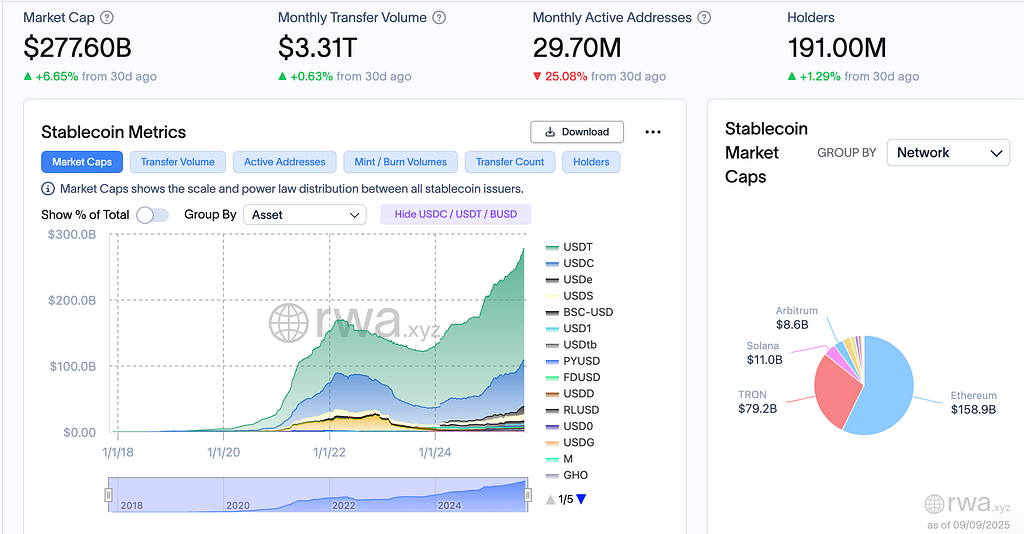
Stablecoin Metrics
RWAs are still in their infancy, but tokenization is accelerating. We’ve seen tokenized U.S. Treasuries, private credit, real estate, and even collectibles like Pokémon cards on-chain. Emerging regulatory frameworks are enabling more major players to participate in the coming months and years.
The leader in issuing institutional-grade RWAs is currently Securitize, who offers products that are just now being integrated into top-tier DeFi protocols like Aave. Whitelisted institutions can borrow against their RWAs on Aave’s Horizon Market, representing a significant step towards deeper RWA integration within the DeFi ecosystem. Currently, this access is mostly limited to institutions, resulting in ample supply but relatively little borrowing activity. That will likely change when web2 companies officially release their own L1 and L2 blockchains.
My prediction is that commodities will be the catalyst that brings DeFi into the mainstream, and I will explain why in the next section. This is the current breakdown of the entire RWA ecosystem as of today according to RWA.xyz:
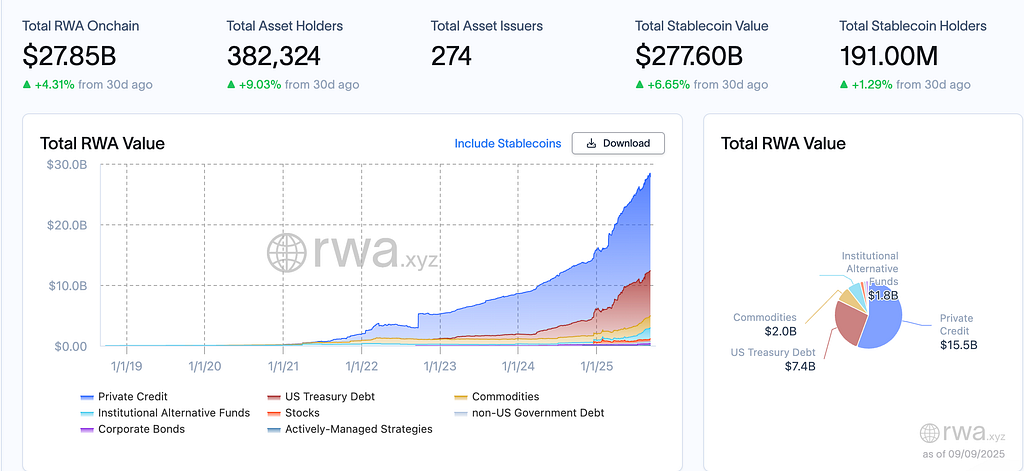
RWA Metrics
Why Tokenized Commodities are bound to explode:
Commodities are generally “boring” assets that don’t experience a lot of volatility, but they are the backbone of the global economy. Oil, gold, metals, wheat, corn — these are the raw materials that drive industries and trade worldwide. Yet these markets are notoriously opaque, fragmented, and gate-kept by large institutions. That is why DeFi is the perfect place for them to flourish…
By tokenizing commodities and bringing them on-chain, we unlock:
- Accessibility: Anyone with a crypto wallet can gain exposure, not just hedge funds and governments.
- Liquidity: 24/7 global trading without intermediaries.
- Composability: Commodities can serve as collateral in lending protocols and fuel derivatives markets.
- Intrinsic Value + Familiarity: Commodities are widely recognized as trusted stores of value.
- Macro Demand for Inflation Hedging: Gold has historically been a hedge against inflation, but it is hard to transport, and cumbersome to store.
- **Sophisticated Investors: Commodities **typically attract risk-averse, professional investors. Exactly what the DeFi space currently lacks.
Imagine borrowing stablecoins against tokenized gold, lithium, or oil, or hedging energy costs in real time — all through a wallet that is accessible anytime.
This could finally push DeFi into mainstream finance. Until now, most DeFi assets — governance tokens, yield strategies — feel abstract or irrelevant to traditional finance participants. Food, energy, and raw materials, however, are universally understood. Tokenized commodities bridge this gap, offering efficient ways to unlock capital with assets people actually depend on. This is how DeFi can speak Wall Street’s language.
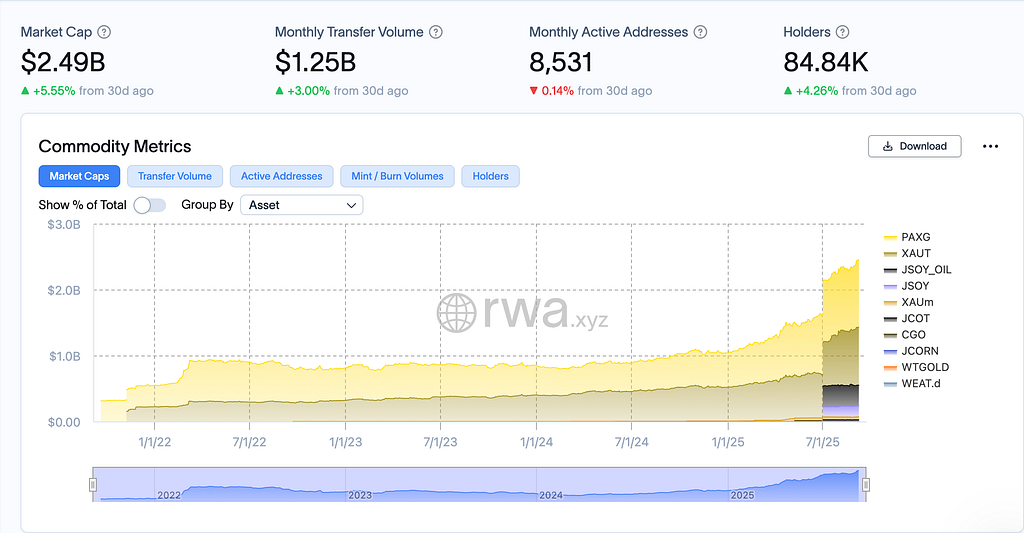
Tokenized Commodity Metrics
We are still very much in the early stages of tokenized commodities. Paxos leads with PAXG, Tether follows with XAUT, and after them, there’s a significant drop-off. Both of these assets are versions of tokenized gold from different issuers. This signifies that innovation has only just begun in this emerging market.
While every company rushes to tokenize stocks and other highly liquid markets, I believe the real opportunity will be to tokenize other commodities. Lithium, silver, copper, platinum, palladium, oil, natural gas, wheat, corn, and other key raw materials are the logical next step.
From MakerDAO to Uniswap to the chaos of DeFi Summer, DeFi has grown through cycles of experimentation and innovation. Now, the stage is set for the next giant leap…
Commodities are the world’s oldest markets; DeFi is the world’s newest. Bringing them together may be the breakthrough that finally pushes decentralized finance into the mainstream.
Thanks for reading. If you enjoyed this, check out more of my research here on Medium. For more niche market deep dives be sure to checkout my Youtube Channel: OnChain Education