The Technical Innovations Powering Solana’s Vision of Internet Capital Markets (ICM)
Equipping “Internet Capital Markets” (ICM) to flourish on Solana is the network’s current north star.
The leading teams on Solana have laid out an ambitious roadmap to address the current limitations and areas of improvement. This article attempts to display the most important parts of the current roadmap and is intended to shed light on the technical ways in which Solana will fundamentally improve over time, in a way that is digestible to non-technical readers.
The ICM roadmap relies on three equally important pillars:
-
Scaling throughput and reducing latency for real-time performance.
-
Ensuring fairness by minimizing MEV and protecting transaction ordering.
-
Enabling flexible market microstructure so applications can cater to their specific needs.
Each roadmap item we discuss in this article strengthens one or more of these pillars. Together, they not only form the foundation for ICM, but also deliver broader benefits for Solana’s ecosystem.
In the near term, incremental upgrades improve Solana’s performance and reliability, but in the long term, three major advancements will position Solana to become the natural home for global capital markets.
The items we will discuss are as follows. Bolded items are major advancements.
Conditional Liquidity P-Tokens + Prop-AMMs + Compute Unit Optimization Block Assembly Marketplace Multiple Concurrent Leaders Alpenglow Asynchronous Program Execution Application Controlled Execution
Before we get too granular, let’s briefly talk about where Solana stands right now.
It is an amazing time to be an advocate, developer, or user on Solana. The developer ecosystem on Solana is thriving. Solana’s application layer is prospering. Platforms like PumpFun and Axiom are generating millions of dollars per day in revenue, and they are both less than a year old. To get a sense for how vibrant on-chain life is, it’s worth nothing that the top 10 Solana apps generated $193.5M in revenue in August alone according to SolanaFloor.
Life on Solana is already whimsical, but it is about to get a whole lot better…
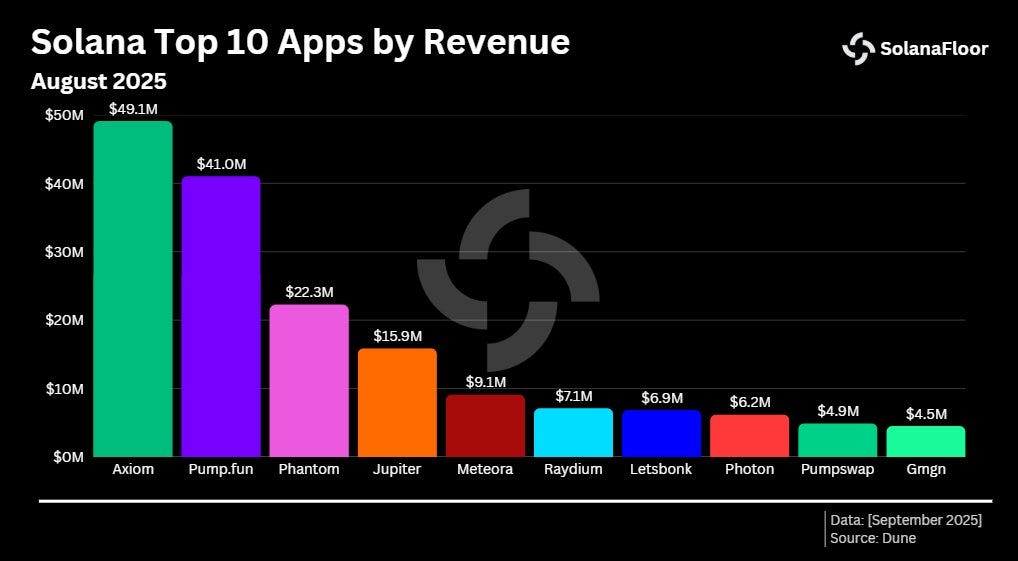
Solana Top 10 Apps by Revenue — Solana Floor
Essential Background Context:
Solana originally set out to build a blockchain “so fast and so cheap that you can put a working central limit order book on top of it” (Anza, 2025a, para. 1), but 5 years later, the goal is still in progress.
Central limit order books (CLOBs) are market structures that legacy players like the New York Stock Exchange and NASDAQ have used to facilitate trading for decades. NYSE and NASDAQ remain the largest trading venues in the U.S. equity capital markets at the time of writing.
Solana aims to compete with them and position itself as the destination for “Internet Capital Markets”. According to flipthe(dot)market, the network is already making significant progress.
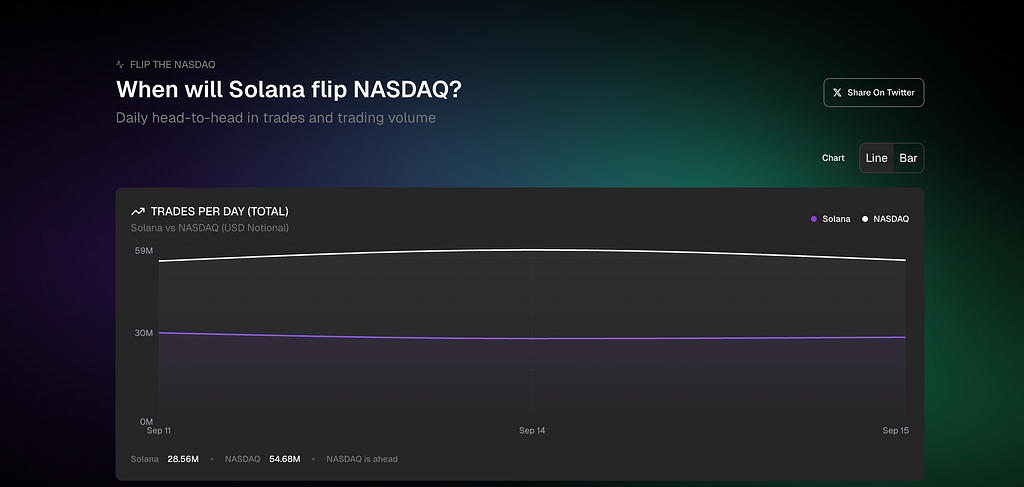
Flipthe(dot)market Trade / Day Dashboard
However, blockchains today are not purposefully designed for trading specifically, so to achieve that original mission, Solana needs to rethink a few major design decisions.
The core task that Solana needs to accomplish in order to compete with legacy players like the New York Stock Exchange + NASDAQ, is to enable exchanges on Solana to provide better prices than centralized entities.
With that in mind, let’s explore how Solana can accomplish this task.
Why Market Microstructures Matter:
In markets, the price of an asset is determined by the bid-ask spread. The spread is the difference between the highest price someone is willing to buy the asset for, and the lowest price somebody is willing to sell the asset for.
**The tighter the spread, the better the price a trader will get, and therefore the more attractive the market will be to trade on. **The spread matters for two essential parties, market makers (MMs) and takers (traders).
The job of a market maker is to provide liquidity. Takers consume liquidity that makers provide. The best market makers have excellent inventory management when it comes to the assets they trade, and this provides them an opportunity to profit off of the spread, among other things.
But there are instances where they can potentially lose a lot of money when large fluctuations in price occur. This allows sharp takers to catch them off-guard and exploit stale quotes. This is one of the risks of being a market maker, and it is called adverse selection. To understand this better, think about it like this:
“Market makers have this idea of a fair price (fair) that changes stochastically over time. When the fair is inside the bid ask spread, market makers’ quotes are safe because takers cannot make a profit by crossing the spread to pick them off. As soon as the fair moves outside of the bid ask spread, a race begins. The market maker tries to cancel their order as fast as possible and takers try to snipe the stale order before the market maker can cancel it. A successful taker earns the difference between the fair price and the stale quote in expectation. A large part of reducing friction from adverse selection is ensuring that the market maker wins this race as often as possible.” (Anza, 2025b, para. 5)
This context is important because:
“Data from centralized exchanges shows that market makers successfully cancel stale quotes and win this race only 13% of the time after a sudden price jump” (Anza, 2025b, para. 6). MMs win this race even less frequently on Solana, so improvements must be made to make on-chain markets more competitive, and tighten spreads.
The reason why MMs win the race even less on-chain, is due to Solana’s **single-leader **design, where one block producer controls transaction ordering during its slot. With this design, some takers effectively get a head start, putting MMs at a disadvantage.
The Jito auction, Solana’s auction for blockspace, further amplifies this issue. Even if a market maker has a faster order, someone else can potentially outbid them for blockspace, which allows the taker to capture value at the maker’s expense.
According to Anza (2025b), “The Jito auction, which is a symptom of having a single proposer who controls access to the state for an extended period makes it nearly impossible for market makers to win the race to cancel their quotes. **Even if the market maker is faster, what really matters for who wins the cancel race is who pays the highest bid in the Jito auction.” **(para.7)
So this leaves MMs in a lose-lose situation, they can either pay a lot of money to cancel their quote, or they can let somebody else pay a lot of money to pick off their quote. In either scenario, they are the loser in this example.
Addressing these intricate microstructure challenges is critical for building vibrant markets on-chain. We need to improve both MM and taker experiences to achieve better prices. As a result, Solana will become a more attractive venue for real-time, capital-intensive trading.
With that as background context, you should extrapolate a few key points.
- The single-leader design is sub-optimal for high-intensity trading, as it creates competition for blockspace between MMs and takers.
- MEV opportunities arise directly from these blockspace battles.
- Good microstructure = MMs and takers are happy = tighter spreads and more liquidity.
- The goal is to improve execution fairness, reduce MEV, and optimize blockspace usage.
Now let’s dive into how Solana is optimizing for what we have discussed so far.
Recent Implementations:
Conditional liquidity (CL):
Conditional liquidity is liquidity that is only available to takers, if the taker order meets a predefined condition. The condition that matters in this case is non-toxic vs toxic flow.
What is “Toxic-Flow”? This is trading flow from those “sharp” takers we just mentioned. It is called “toxic” because the maker will find themselves to be out-of-the-money nearly immediately after the order is filled. This occurs most frequently when a taker has an information or latency advantage, and punishes the maker as a result.
What conditional liquidity is actually doing, is ensuring that a given unit of liquidity can only be taken if the taker order is endorsed by a known front-end application. Places like Jupiter, Kamino, Phantom, Backpack, and many other good-faith entities. Think of it almost like a bouncer letting people into a bar. As a bar owner, you don’t want patrons who enter your bar to create problems for other patrons who are making the atmosphere enjoyable.
Conditional liquidity helps create tighter spreads, because market makers won’t have to worry about their trades getting picked off as frequently by toxic takers. CL basically lets liquidity providers avoid giving their best quotes to flows that are more likely to be toxic, and that is a good thing for everyone else.
Dflow is the pioneer of this mechanism and they recently published an open-source “conditional liquidity crate” that DEXs can integrate. CL is one of the many upgrades helping to make ICM a reality.
Next we will talk about how transaction processing will improve.
P-Tokens + Prop-AMMs + Compute Unit Optimization:
Transactions that are performed on Solana don’t just happen, they require a validator to execute the instructions, consuming compute units (CUs) in the process. This matters because each block has a finite compute budget. For example, a single instruction can consume up to 200k CUs, while an entire transaction is capped at 1.4M CUs.
We have recently witnessed the benefits of CU optimization through the rise of prop-AMMs. Platforms like Humidifi are able to capture large trading volume via lightweight oracle updates using as little as 143 CUs, enabling far more efficient price discovery. For comparison, this is orders of magnitude cheaper than the thousands of CUs consumed by a typical swap routed on Jupiter, whom is increasingly directing flow through prop-AMMs today.
Further optimizations to compute bring us to the introduction of the Pinocchio Token (p-token), which reduce CU consumption for typical SPL token transactions by roughly 95%. Since token transfers are common operations on Solana, this efficiency gain frees up significant blockspace to process additional transactions, directly improving network throughput.
Additionally, Solana is working to expand blockspace to 100M CUs per block, a target that can be reached through several upcoming improvements we will now explore.
Block Assembly Marketplace (BAM):
Jito’s Block Assembly Marketplace is a high-performance transaction processing system that gives Solana validators, traders, and applications powerful new ways to enhance performance and generate value.
“BAM transforms Solana blockspace into an open sandbox where developers can build modular programs that add functionality to transaction processing.” (Anza, 2025b, para. 15)
BAM is similar in nature to one of the major advancements we will talk about at the end of the article, but not quite the same.
The way BAM works is by “introducing an encrypted mempool running inside Trusted Execution Environments (TEEs), where all transactions remain confidential until execution.”, giving developers more control over transaction ordering which unlocks a host of new capabilities.
“This architecture aims to significantly reduce, if not eliminate, many of the most extractive forms of MEV, providing users with stronger execution guarantees and better pricing.” (Helius, 2025, para. 2)
BAM’s capabilities are impressive, and directly address the pillars outlined at the beginning of the article. It can enable apps to implement customizable sequencing rules, allowing Central Limit Order Books (CLOBs) that rival traditional exchanges to exist.
“CLOB plugins can run inside BAM and rely on a mixture of off-chain and on-chain logic, allowing full transparency and deterministic execution.”
But there are more benefits than new financial primitives…
“Validators earn more through better block construction. Users get faster, cheaper, and more reliable execution. Professional traders gain unprecedented trust in Solana’s infrastructure because BAM’s open source and verifiable nature will guarantee fairness with no hidden games or backdoor deals.” (Anza, 2025b, para. 10)
Better block construction from customizability of the blockspace should result in a decrease in computational resources that validators have to use for transaction execution, revealing yet another improvement in efficiency and throughput.
The items we have discussed so far are already live and pushing Solana closer to enabling ICM, but there are still many more important unlocks that we must acknowledge that are forthcoming.
Alpenglow:
Alpenglow introduces a new consensus protocol, which is the biggest protocol change that Solana has ever had.
Alpenglow ditches legacy components of the core protocol, specifically TowerBFT and occasionally Proof-of-history. Instead it introduces Votor, which according to Anza (2025a, para. 2), “takes over the voting and block finalization logic. Moreover, rather than relying on gossip, Alpenglow adopts a faster direct communication primitive.”
These changes will catapult Solana to an unprecedented performance level. The team at Anza can explain why more eloquently than I can.
“With TowerBFT, Solana had about 12.8 sec from block creation until block finality. To bring latency down into the sub-second domain, Solana introduced the “optimistic confirmation” concept. Alpenglow will shatter both these latency bounds” (Anza, 2025a, para. 4)
“We expect that Alpenglow can achieve actual finality in about 150 ms (median). Sometimes finality can be achieved as fast as 100 ms, which is an unbelievably low number for a world-wide L1 blockchain protocol.” (Anza, 2025a, para. 5)
To clarify, finality can depend on factors like a validators geographic location, but nevertheless, this is an **enormous and borderline obnoxious **efficiency upgrade.
“A median latency of 150 ms does not just mean that Solana is fast — it means Solana can compete with Web2 infrastructure in terms of responsiveness, potentially making blockchain technology viable for entirely new categories of applications that demand real-time performance.” (Anza, 2025a, para. 6)
If you are a Solana user, you already know it is fast, but Alpenglow is about to redefine the very meaning of the word. Real-time performance is right around the corner.
Anza is targeting early 2026 for Alpenglow activation on mainnet. This is the most important advancement we have discussed so far, but we still have the most exciting upgrades ahead.
Asynchronous Program Execution (APE):
Asynchronous Program Execution (APE) removes execution replay from the critical path of transaction landing, reducing latency even further. In practice, this means that transactions can settle faster without the need for every validator to re-execute them before confirmation.
This has been a goal Solana has been working to accomplish for multiple years. With the improvements Alpenglow provides to consensus, it removes a lot of the complexities that were initially required to implement APE. So because of the reduction of latency Alpenglow provides, APE can exist, and reduce latency even further.
APE presents a lot of advantages:
- Faster block times
- Lower validator requirements
- Faster Finality
- Reduced window for reordering transactions (combating MEV further)
- Provides a pathway to multiple concurrent leaders (we will visit this very shortly)
Anza expects it to be activated on mainnet shortly after Alpenglow rolls out in early to mid 2026. Now let’s discuss one of the most exciting roadmap items.
Multiple Concurrent Leaders (MCL):
Remember how we briefly talked about the single-leader system that was creating problems for MMs? Well Solana devs are cooking up a new mechanism that will change the fabric of the blockchain.
Maximum extractable value (MEV) on Solana exists from chain operators squeezing out small units of value from users. MEV on Solana typically occurs because block producers, called “leaders” have a monopoly for transaction inclusion when it is their turn to produce a block. This allows for “searchers” (entities looking for MEV opportunities) to take advantage of certain situations that can occur when a leader is producing a block.
The solution to this problem, is to change the single-leader mechanism that currently exists, to instead have multiple leaders producing blocks simultaneously. This levels the playing field and takes away that monopoly that currently exists with having a single-leader producing a block.
In Anatoly Yakovenko’s words, “The approach that Solana is taking (to minimize MEV) is to maximize the competition between leaders (aka block producers) that have a monopoly for transaction inclusion. This means minimizing slot times, minimizing the number of consecutive slots a single leader is scheduled for, and maximizing the number of concurrent leaders scheduled per slot.”.
This gives users some optionality…
“The more leaders per second, the lower the costs for good leaders to offer blockspace, the easier it is for users to exclusively transact with good leaders and exclude transactions from bad leaders.” (Yakovenko, 2024, X.com, March 2024, para. 2)
MCL will help maximize information propagation in financial markets, which is currently constrained in the world of Centralized Finance. In CeFi, geographic location presents a significant advantage to market makers, which can end up hurting takers who may have earned an edge originally. You can think of this in the opposite way for blockchains regarding how single-leaders disadvantage MM’s currently.
The way these improvements converge, is that “Solana is simultaneously improving execution for makers via conditional liquidity and takers via Multiple Concurrent Leaders”, (Samani, 2025, para. 12) improving the capabilities of both parties, and therefore creating a more attractive capital market on Solana.
MCL does not have a definitive timeline, and we shouldn’t expect anything concrete until after Alpenglow is fully deployed and stable.
The Final Puzzle Piece:
According to Anza, we need 3 things to build the most liquid markets on-chain.
- The chain must have more than enough capacity to ingest all market-relevant information in real time at line rate
- The chain must have fast confirmations and an even faster tick rate (slot time)
- The chain must allow applications to control their own execution ordering in order to facilitate experiments with new market microstructures
The items we have discussed so far have addressed the first two points sufficiently, and BAM partially attempts to cover the third.
Application Controlled Execution (ACE) will fully enable the third.
Although BAM is similar in nature to ACE, it is not the full solution. BAM introduces custom sequencing within block assembly, but ACE extends that flexibility to the protocol level, giving applications true control. This brings us to the last unlock on the roadmap, which combined with the items we previously discussed, will change everything for Solana.
Application Controlled Execution (ACE):
At its core, ACE shifts the power over transaction ordering away from validators and into the hands of applications themselves.
In today’s single-leader design, one validator controls which transactions are included, and the order in which they are executed during its leader slot. This makes applications vulnerable to sub-optimal sequencing, which open the door to harmful MEV, and other scenarios we discussed earlier like MMs being at a disadvantage while racing to cancel stale quotes.
ACE changes that. By letting applications define their own ordering logic, Solana enables apps to customize execution in ways that protect their users and make markets healthier. For example, NFT platforms could randomize order to make mints fairer. Lending protocols could prioritize liquidation transactions deterministically, reducing chaos during volatile events. And a whole lot more…
The bigger picture is that ACE allows Solana’s app layer to support multiple market microstructures simultaneously, without being constrained by a single, one-size-fits-all ordering scheme. This flexibility is critical for meeting the requirements to build Internet Capital Markets (ICM), where each market may require a unique balance between fairness, latency, and determinism.
Like we touched on at the beginning of the article, blockchains aren’t usually designed for one specific thing. Most L1 blockchains like Solana are multi-purpose.
The problem with multi-purpose chains is that if you want to do a very specific thing on-top of them, the infrastructure may not be optimal for that specific thing you want to accomplish.
Solana and the technical innovations we discussed in this article, directly address all of the areas in which it can improve to meet the standards of what ICM should be, and transport the masses over from centralized platforms to decentralized finance.
Thank you for reading. I hope you enjoyed.
References:
- Anza. (2025, May 19). Alpenglow: A New Consensus for Solana. Retrieved from https://www.anza.xyz/blog/alpenglow-a-new-consensus-for-solana
- Anza. (2025, July 24). The Internet Capital Markets Roadmap. Retrieved from https://www.anza.xyz/blog/the-internet-capital-markets-roadmap
- Anza. (2025, May 8). The Path to Decentralized Nasdaq. Retrieved from https://www.anza.xyz/blog/the-path-to-decentralized-nasdaq
- Helius. (2025, August 1). Block Assembly Marketplace (BAM). Retrieved from https://www.helius.dev/blog/block-assembly-marketplace-bam
- Yakovenko, A. (2024, September 18). X Post: 1804937522998591577. Retrieved from https://x.com/aeyakovenko/status/1804937522998591577
- Yakovenko, A. (2024, September 18). X Post: 1810222589991583922. Retrieved from https://x.com/aeyakovenko/status/1810222589991583922
- Multicoin Capital. (2025, January 22). The Solana Thesis: Internet Capital Markets. Retrieved from https://multicoin.capital/2025/01/22/the-solana-thesis-internet-capital-markets/
- BAM Community Forum. (2025, August 1). Brainstorming Paths to ACE on BAM. Retrieved from https://forum.bam.dev/t/brainstorming-paths-to-ace-on-bam/28