The Problem with “Crypto-Native” Assets
This article talks about the problems that “crypto-native” assets are causing within the blockchain space. We discuss the 6 different “types” of crypto-native assets, the disappointing outcomes of M&A in the space, and the questions we need to address as an industry.
A switch recently flipped in everybody’s head… “what is it that we are buying and holding?”. This is a question we all ask ourselves every year at one point or another. We did it with ICOs, we did it with NFTs, and we are doing it right now with different “types” of crypto-native tokens.
The switch was triggered by multiple events over the course of this year, but the most recent example was the Vector acquisition by Coinbase.
The team behind Vector (and also Tensor), is a team that the community on Solana trusted and championed (for good reason!). These guys are real builders, they disrupted a major player in the NFT market, and are generally incredibly sharp/impressive. Surely buying exposure to their token would pay off in some way, right?
Wrong! Coinbase acquires Vector, and responsibly notes in the announcement tweet, “Coinbase is only acquiring Vector. The Tensor Foundation will remain independent from Coinbase and will steward the Tensor NFT marketplace and native token, which will remain independent and unaffiliated with Coinbase.”.
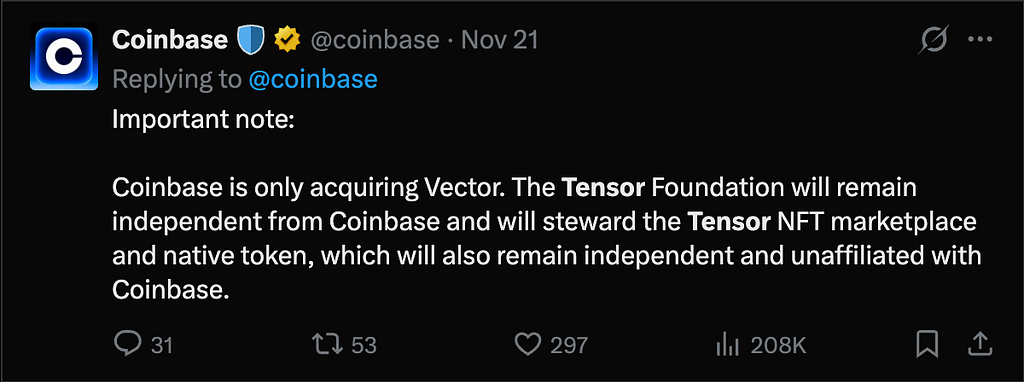
Coinbase Tweet, November 21st, 2025
In other words, Coinbase basically said we want the retail order-flow + Solana Dex trading tech, but nothing else. Good luck with “stewarding the token!”.
Tensor Foundation, now faced with an interesting situation where they should be happy + proud, but are now paranoid about the wrath of angry tokenholders storming their comments, start the damage control efforts promptly.
They claim that this is actually an incentive alignment benefit, and it comes with:
- 50% increase in marketplace fees going to the TNSR treasury.
- The teams unvested tokens, to the tune of 21.6% of the supply, gets burned immediately.
- And the founders are re-locking their vested tokens for 3 more years.
Sounds like a decent remedy on paper, but the core questions remain… what actually IS the $TNSR token? Why have people been holding it?!
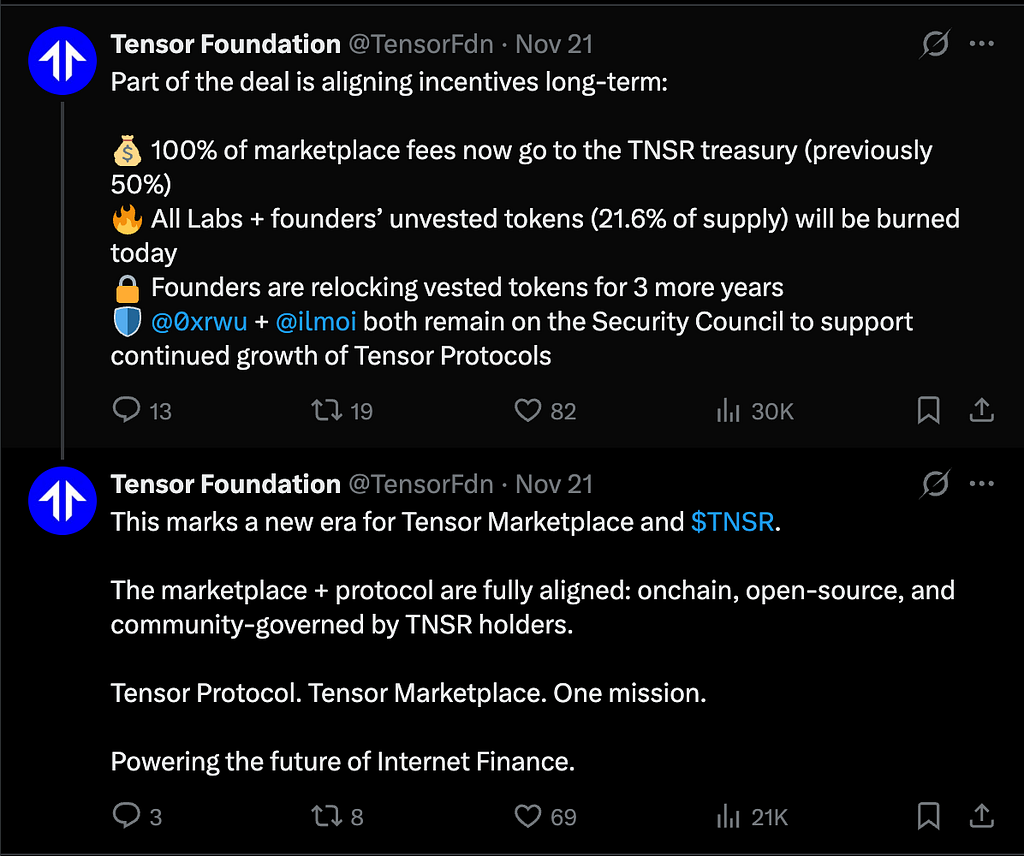
Pictured above is the tweet they put out. Naturally, the response from token holders wasn’t necessarily positive, or friendly. (see below)
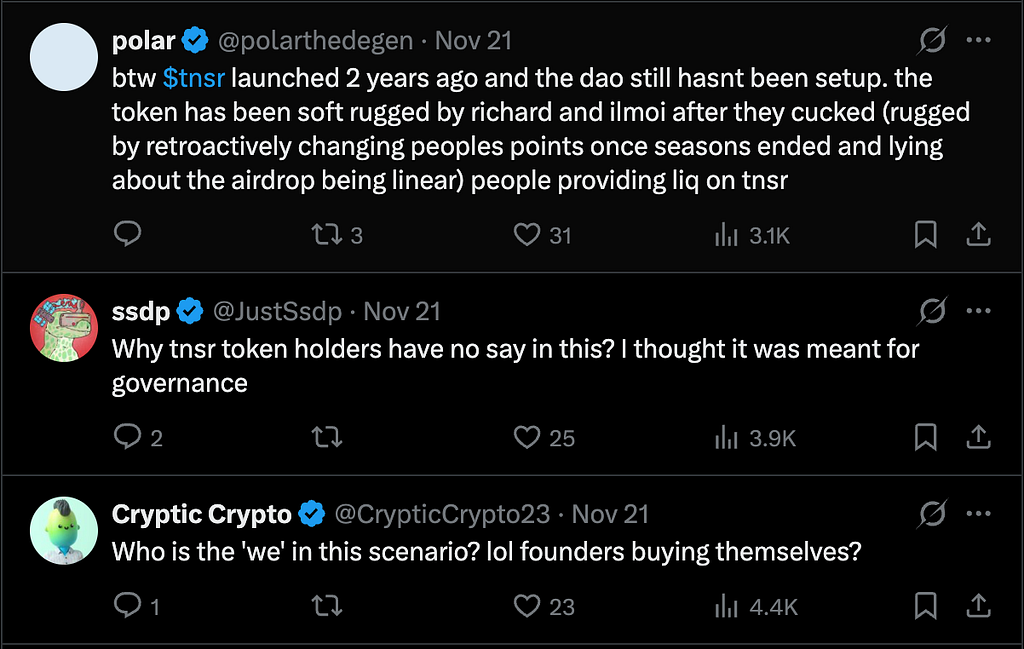
Angry reaction from CT
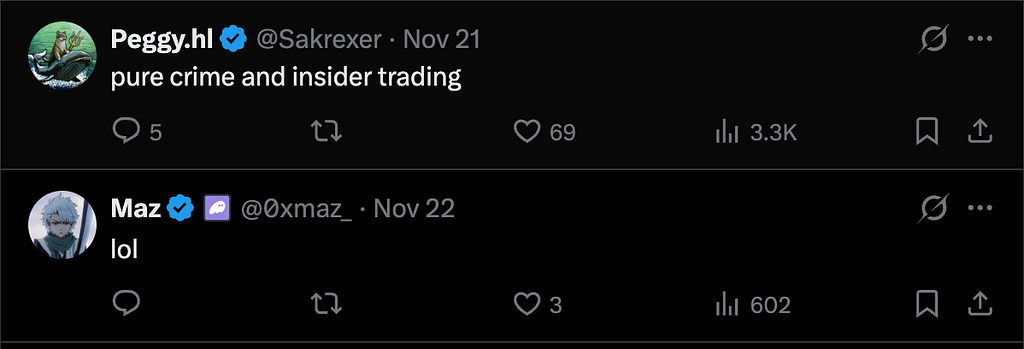
Angry reaction and accusatory claims from CT
The hate-fueled reaction from CT is par for the course over ANY minor snafu, but in this situation most of the space actually shares the same sentiment. How do we gain exposure to these projects if not through the token? What is the token’s purpose? How do we even value assets or hold them if they can’t be clearly defined?
The anger from CT stems from a few reasons. One of them being the fact that interestingly, the TNSR token started unnaturally pumping on the 19th of November, two days before the announcement was released. This is what triggered some comments about insider trading.
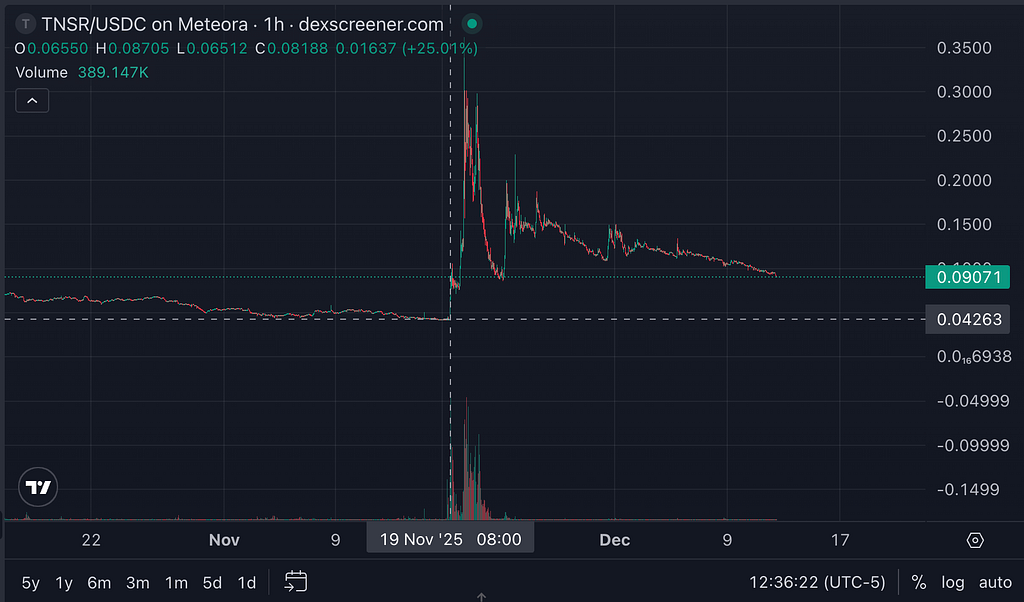
TNSR price on November 19th
But the real reason CT is so angry, is due to the fact that the equity holders are the only group able to celebrate the acquisition. The community, which helped them get to where they are today, is once again left with nothing but questions and a tide pod in their mouth.
Token holders feel a deep sense of disappointment over being left out. They feel cheated. They did all of the right things on paper…
They helped the team by providing their own hard earned capital as liquidity. They spotted a great opportunity and held what they thought was skin in the game (TNSR tokens). “Why shouldn’t we be rewarded for this risk?!”.
They are right. Buying exposure to the $TNSR token theoretically should payoff in some way after a Coinbase acquisition if the token actually had any inherent value. They were duped by not understanding the game.
The community reaction to this, and many similar situations, is to not forgive and/or forget, but to just stop participating.
The feeling of defeat that you get knowing that the risk you took + the time you wasted holding a token was not only meaningless, but actually adversarial toward you is one that is indefensible. Token holders have a right to be pissed off and demand change, because this has been a constant in the crypto ecosystem for as long as I have been apart of it. The difference back then was that people had **legitimate fears about issuing securities by accident. **Now it is simply that founders discovered a “new meta”. Raise money without giving up any piece of the pie. Comes with the added perk of not having to deal with the tedious process of VC rejections or appeasing investors.
Many of those tokenholders will forever hold a grudge against Vector, Tensor, and Coinbase because of this. This in my opinion is one of the main reasons why so many new users churn within crypto.
Classic scenario: Friends or family have a horrible experience with crypto after Timmy told them to buy Fartcoin at Thanksgiving dinner. Or they lose a bunch of money by buying an illiquid honeypot token, or clicking a malicious “free solana” button. They get drained and rightly feel cheated. They then tell everyone they know that it is a perma-scam made by drug dealers. These rumors spread like wildfire and are the main reason why crypto has such a horrible stigma.
It is even easier to get people to hate crypto if you explain to them that what they bought was supposed to be a “governance” token. I mean the concept of these things was acceptable at the time, but now we know that they are laughable. The problem with tokens as governance is simple, the “insiders” (team, investors, equity holders) typically hold most of the supply, and nobody actually votes except for them anyway. These are entirely useless.
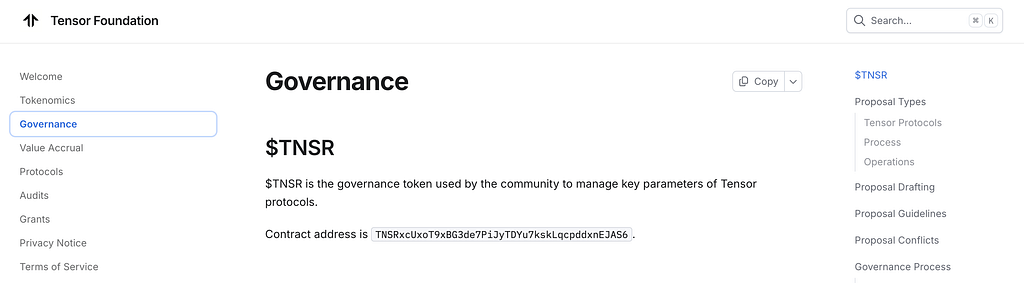
Screenshot from Tensor Documentation
$TNSR was and still is just a non-functional governance token the entire time. There was no financial incentive to hold it, much like many other tokens that are currently “tied” in some way to successful projects in the space. People only want to buy a token and support a team if they know they have a financial incentive to do so. This is why there is a “ghost-bid” on everything right now. There is no financial incentive to hold basically any of these things. (but there is hope as we will discuss!)
There are many examples of crypto M&A resulting in situations like this, where the “native token” is left for dead, and yet we still wonder why a lot of these coins never attract real capital. If we want to be taken seriously, we need to restructure many of the tokens that are currently available on the market. They need to represent real ownership, ideally through equity and dividends.
A very similar situation happened when PumpFun acquired a trading terminal called “Padre” in October. In their version, they were more blunt about the announcement. They tweet, “the $PADRE token will no longer have utility on the platform, with no further plans for the future.”. Imagine being a long-time supporter of Padre just to see that tweet come out. It also must be disheartening to be on the Padre team and see an “asset” that you brought into the world, negatively impact all of your original supporters. Standards need to be raised all around.
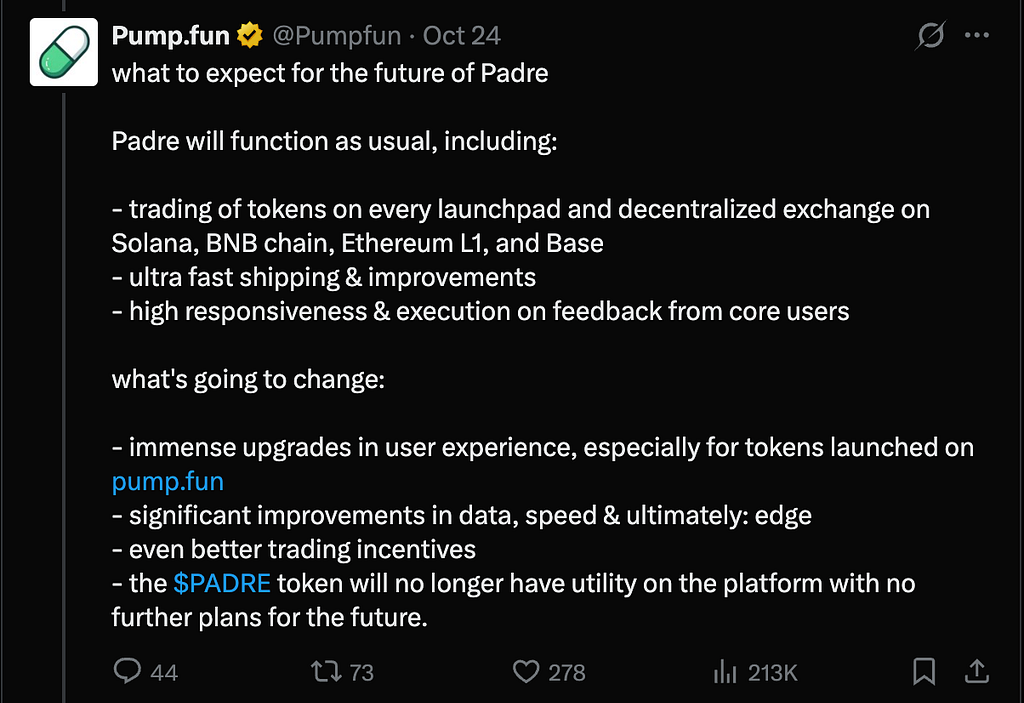
Padre Acquisition Announcement, 10/24/2025
PumpFun has also taken down the Padre team’s Medium articles and documentation regarding the original token details. Apparently it actually had some useful utility, all for it to be destroyed in one day. Here is a screenshot of the price chart. Notice what happens to price in October.
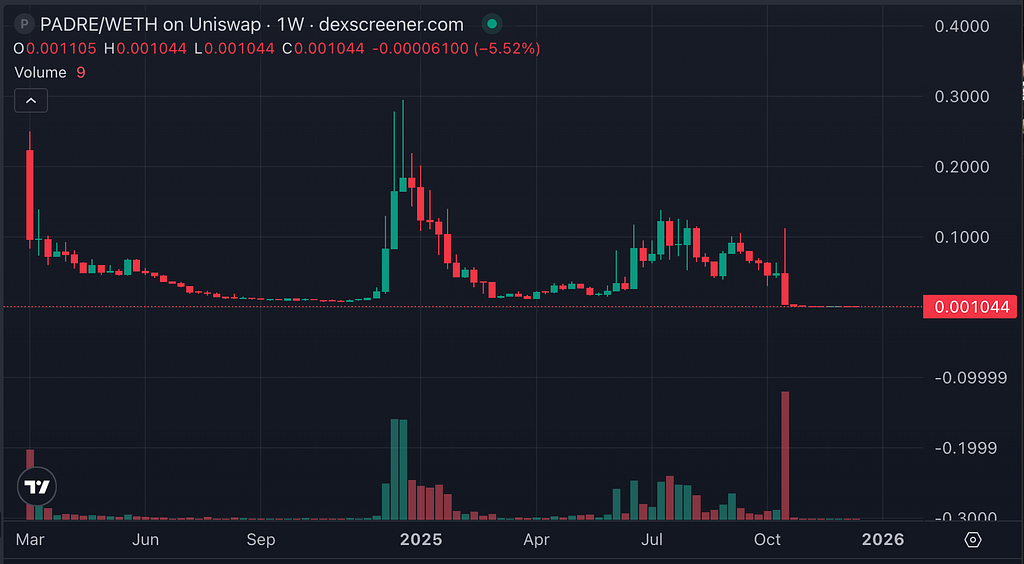
The sad part is, another example of this just happened as I have been putting this article together. Yesterday, December 15th, Circle acquired Interop Labs, the team that developed Axelar, and once again left token holders with nothing but dismay. This is impacting the growth of the industry and leaving new-entrants who aren’t used to this stuff disgusted. I like to say, “if you don’t understand the game you are playing, you shouldn’t play the game”, but I don’t think anyone actually understands the game we are currently playing by holding these tokens. If that were the case, Solana and Ethereum would have closer valuations, and memecoins wouldn’t go to $1B marketcaps.
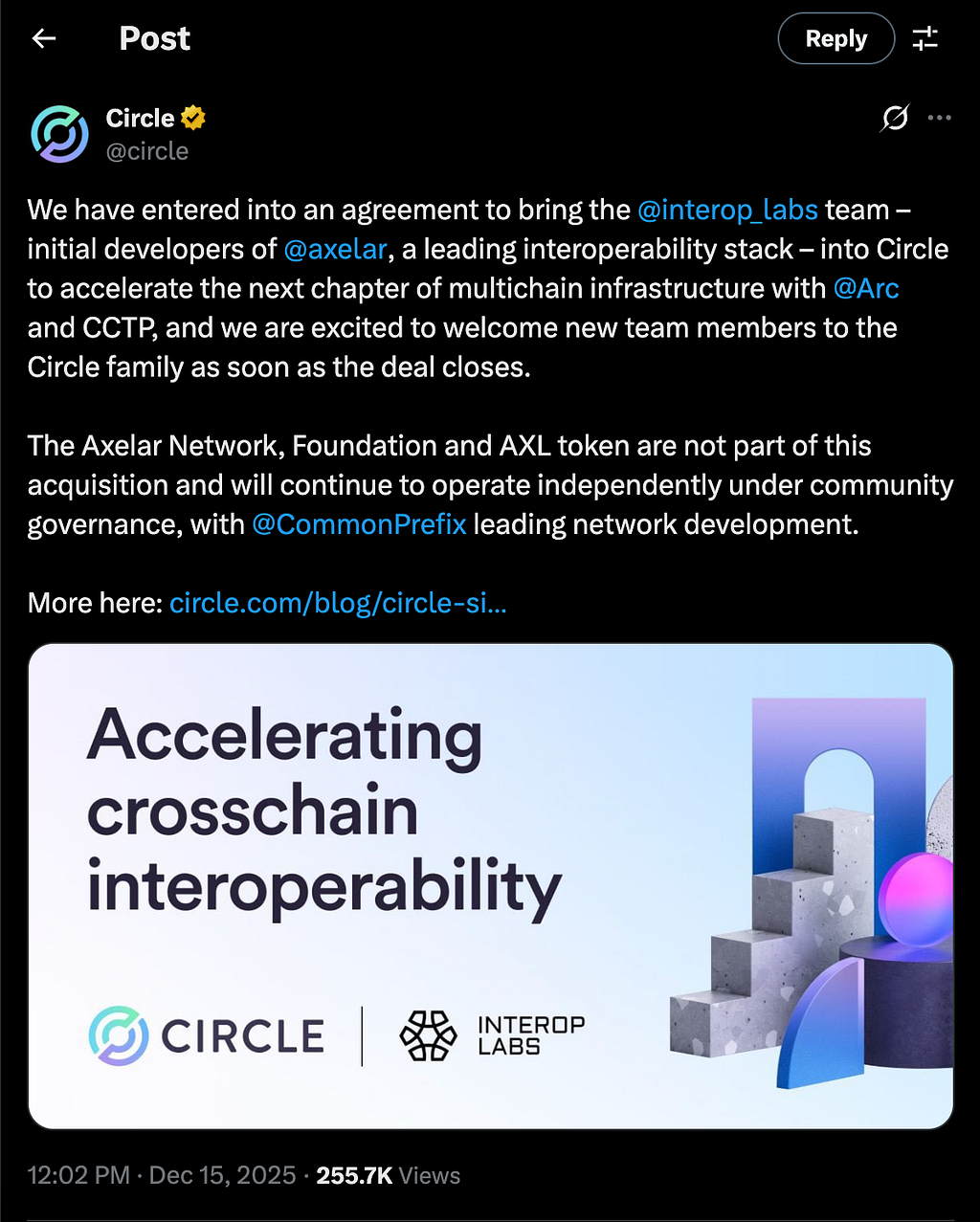
Circle acquisition of Interop Labs demonstrating the same scenario. December 15th, 2025
Nobody is going to want to invest in “crypto-native” assets if “token vaporization” is a possible outcome. The challenging part is that we need “crypto-native” assets if we want to continue growing, or else people will just keep trading where they already do, with assets they already know and trust.
New assets that were generated from this space like ICOs, NFTs, and memecoins unironically bring a ton of new users into the ecosystem. If we want to keep it that way, we need to also have assets that aren’t solely speculative to remind people that we are building a serious one-stop-trading-shop. Not just a virtual casino.
From what I observe, a lot of the current “crypto-native” tokens on the market are basically un-investable for rational people. The current standards around tokenholder rights is wildly insufficient. That is why we are currently seeing a lot of dissonance regarding token “types” in the space. I tend to think that there are basically 6 “types” of tokens that exist right now in the crypto space. And this has evolved over the past 5 years since ICO’s were all the rage.
- “Memecoins” — tokens with no value whatsoever. Just for speculation and entertainment. You know what you sign up for when buying these.
- “Governance” Tokens — many of the tokens that exist today grant “governance” rights to holders. This is cope in tokenized form, a failing model. Essentially on the same tier as a memecoin atp.
- “Utility” Tokens — fee rebates or tier thresholds that grant certain access to the product’s functionalities. Almost like a paywall that you bypass through holding certain amounts of tokens. These don’t really work either, but are much better than the previous two. The token actually has a real economic purpose.
- “Value accrual” Tokens —a percentage of revenue that is generated from the project’s underlying product goes toward token buybacks. These have the correct properties, but arguments posed about startup capital allocation are still important to consider. Many agree that there are “good” token buybacks and “bad” ones.
- “Ownership” Tokens — currently being pioneered by MetaDAO, these take on an entirely different approach that is becoming more widely accepted across the ecosystem. Basically, token holders vote by expressing intent through skin in the game, forcing all parties to make the “right” decision. If they don’t they will have a financial consequence on either side of the outcome.
- “Network” Tokens — things like Solana, or Ethereum. With these you know what you are getting, and the utility in them is clear. You need the token to interact with the network (paying to transact). A story for another day will be how value will accrue to these, as that is a hot-topic right now as well.
The optimal path forward is not totally clear to some yet, but hopefully we can all agree on a standard soon.
In my opinion, we should copy the model that already works in other markets. Equity and dividend distributions directly to token holders.
There needs to be common ground on this: Either issue tokens that represent equity, or distribute equity without a token. No more hybrid models trying to incorporate both. That is how these perverse incentives start to form.
One thing is certain, “crypto-native” assets still have a LONG way to go.
It appears that participants from every ecosystem are starting to agree on one thing, we need to address this ASAP.
Right now, teams seem to have a “get out of jail free” card that they can pull out when being asked about their token. Most of the teams launching tokens today are sure to include a peculiar disclaimer, that usually reads something along the lines of “this token should not be considered an investment” or “more details to come in the future”.
This has become a cop-out way of saying “our token doesn’t technically give you anything yet because we don’t know what we can or cannot do with it due to regulatory concerns”. This in my opinion is one of the biggest roadblocks that we must collectively fight to overcome within the ecosystem. You can’t just point at uncertainty and use it as the reason to create more uncertainty in the world.
Ideally, these teams would just avoid launching a token if they do not know what they can or can’t do legally. But crypto doesn’t operate like that.
Most of the tokens that have launched to date have provided vague descriptions on what it is that they are actually granting holders. This is mainly due to the Howey Test, which prevents tokens from distributing things akin to dividends, or equity in the business. This would classify the token as a security, which is not kosher in the US and other major countries where teams are building. This is what allows teams to have this quasi “get out of jail free card”, and it enables them to raise a ton of money through the token launch, with no definitive responsibility to do right by the investor.
This is preventing new entrants from experimenting with these tokens. Why would you ever invest in something that you can’t clearly understand, or even confidently say what it is that you own?
For DeFi to realize its true potential, a few things need to happen.
First and foremost, we need to really increase the quality of the assets we have available to lend, borrow, or provide liquidity for. This starts by clearly being able to define every token in the space. If that means restructuring or even relaunching a token, so be it. We need to address this head on or people will lose all faith in “crypto-native” assets. If we are still unable to do right by investors because of a lack of “regulatory clarity”, then we simply just need to increase our effort in the areas where we do have clarity, and start tokenizing more traditional stocks and commodities so that people have assets they can trust available to trade on these networks.
Secondly, we need to raise the standards of token launches + launchpads. This won’t be easy because a launchpad’s natural financial incentive is to try to launch as many things as possible, which is deeply problematic for a number of reasons. But thankfully, companies like MetaDAO are approaching this with tact.
No longer can we provide teams the luxury of releasing a vague and uninspired roadmap that points to the future and says “we will figure it out later”. These two things alone will greatly increase the willingness for investors to actually consider holding these assets, and importantly, it will enable people like me, who genuinely want to onboard new people into the space, to confidently be able to describe exactly why it is lucrative to participate within this ecosystem. This is how we actually bring everything and everyone on-chain.
The thing that many crypto-native builders do not recognize is that the rest of the world who isn’t spending their time chronically online investing in internet “currencies” are typically very risk-averse. They want slow, steady, consistent, low risk investments that they know will grow overtime. They don’t want to check their portfolio one day and see that the token they bought for a project they believed in last year got acquired, but the token was left for dead. This isn’t a risk that people investing in the equities market have to price-in, and it shouldn’t be a risk in our markets either if we want them to be taken seriously.
Furthermore, I believe this is the core reason why holding times for crypto assets is typically so much shorter than holding times for other assets.
Token holders are basically playing a zero-sum version of hot-potato with their portfolio. Things can change so quickly in the space that you have constant paranoia holding most of these tokens. Individuals are now being rugged through the thing that used to signal an absolute grand-slam success! (an acquisition)
So the takeaway here is that we need to clearly define onchain assets while continuing to bring traditional assets onchain that have already established demand in other markets. Tokenized equities will probably be the most coveted onchain assets within the next 2 years. I have already written about commodities and why I think they will have a massive impact as well, but now I am starting to think that both will be equally transformative. (can check that article out here)
Crypto-native assets will also have a great rise in demand as soon as we start labeling them appropriately and ensuring that investors have basic rights. On a positive note, at least you can say you got to witness the period of time in crypto where we all knowingly bought and held vaporware disguised as governance. We are still quite early.
According to data from Defi Development Corp and RWA.xyz, tokenized stock trading volume on Solana surpassed $1.1B so far this year. This data was released on October 16th.
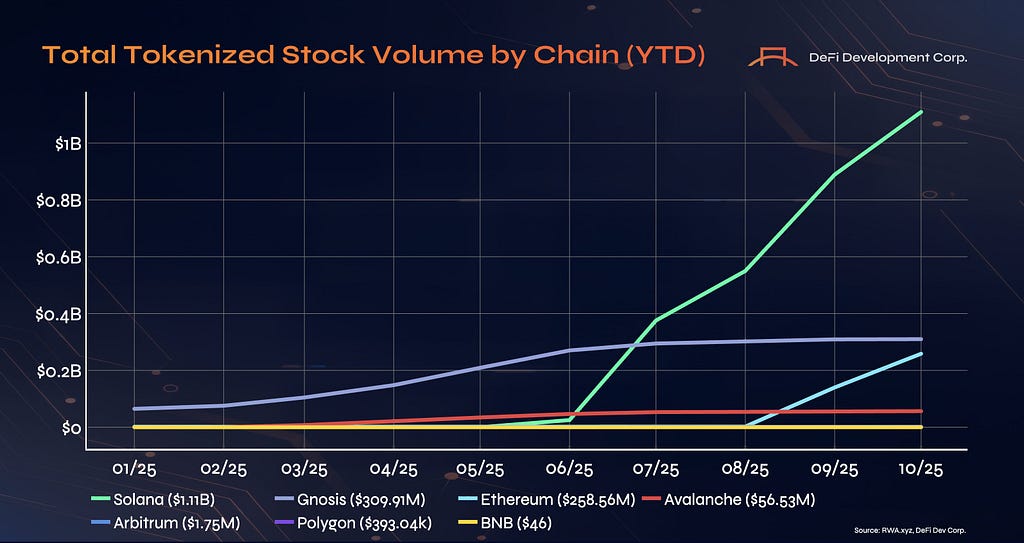
Notably, they pointed out that tokenized stock volume on Solana essentially doubled MoM from August to October, signaling real demand for these assets during a short span of time.
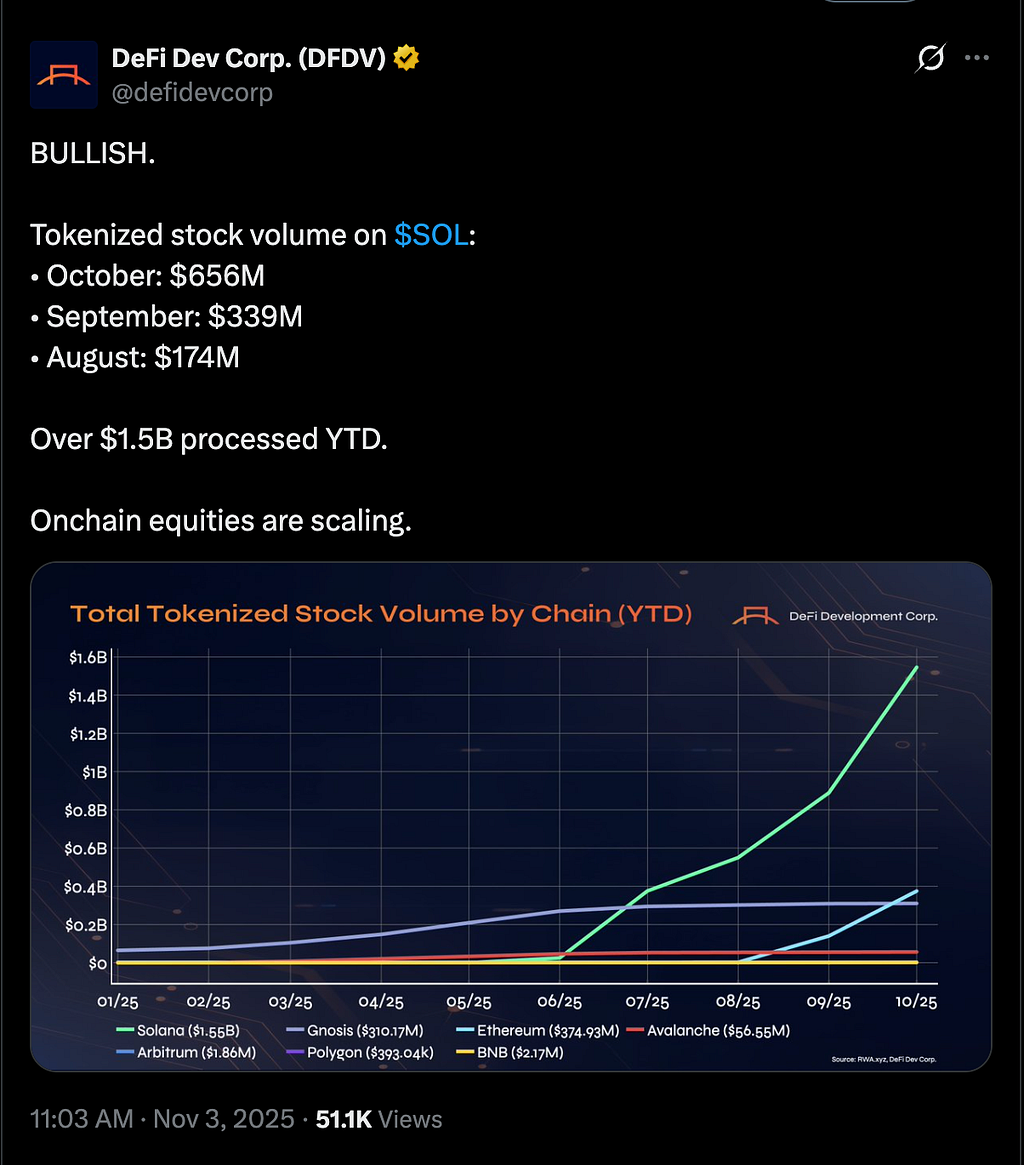
There is no doubt that tokenized stocks will be an interesting vertical within the crypto markets, and hopefully tokenized equity will become the standard for crypto-native assets.
Importantly, regulatory clarity should be coming very soon for everything. On December 12, 2025, big news dropped. “DTC received a No‑Action Letter from the SEC to tokenize certain DTC‑custodied assets. By leveraging blockchain, DTCC aims to bridge TradFi and DeFi, advancing a more resilient, inclusive and efficient global financial system.”.
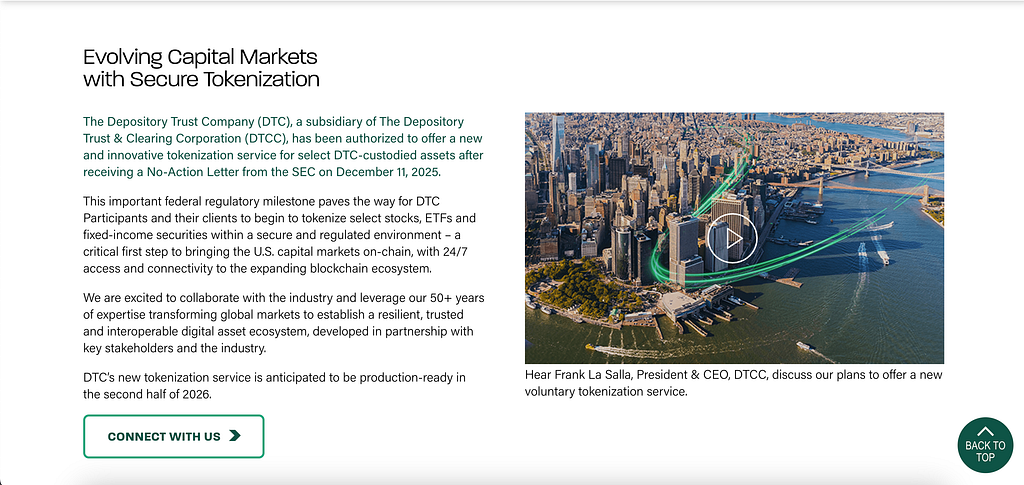
This is a major step forward, allowing for assets like the Russel 1000 to be tokenized on blockchains. Bingo! Better assets are on the way!
This is an on-going fight, and there are so many questions that need to be answered from a regulatory perspective which is certainly prolonging the timeline. Until we figure out the optimal way to structure tokens on-chain, DeFi will not reach anywhere close to its full potential. It is imperative that people are able to lend/borrow/trade assets that they can actually trust.
Pragmatic investors do not want to buy tokens that cannot answer even the most simple of questions, which unfortunately still are as basic as “what are we getting when we buy your token?”. So in the meantime, while we figure out the answers to those questions, the stage is set to bring in assets that already have those questions answered. This is how we bring serious capital from serious investors onchain.
Thanks for reading.